 PingPal
Table tennis doubles serving order, explained step by step
Doubles serving is the part of table tennis that causes the most arguments at the table. The rule itself is short; it just never feels obvious in the middle of a rally. Here is the whole thing, with a worked example you can follow with four players.
The one rule behind the rotation
Each player serves two points in a row, just like in singles. When the service changes, the player who was receiving becomes the server, and the partner of the previous server becomes the receiver. That is the entire rotation. It walks around all four players in a fixed circle.
A worked example
Say A and B play against X and Y. A serves to X first.
- A serves to X for two points.
- X was receiving, so X serves. The receiver is the partner of A, which is B. X serves to B for two points.
- B was receiving, so B serves, and the receiver is the partner of X, which is Y. B serves to Y for two points.
- Y serves to A for two points.
- Back to the start: A serves to X, and the circle repeats.
So the order is always A → X → B → Y, and each player receives from the same opponent every lap. Nobody picks freely in the middle of a game; if you know the first two players, the rest is fixed.
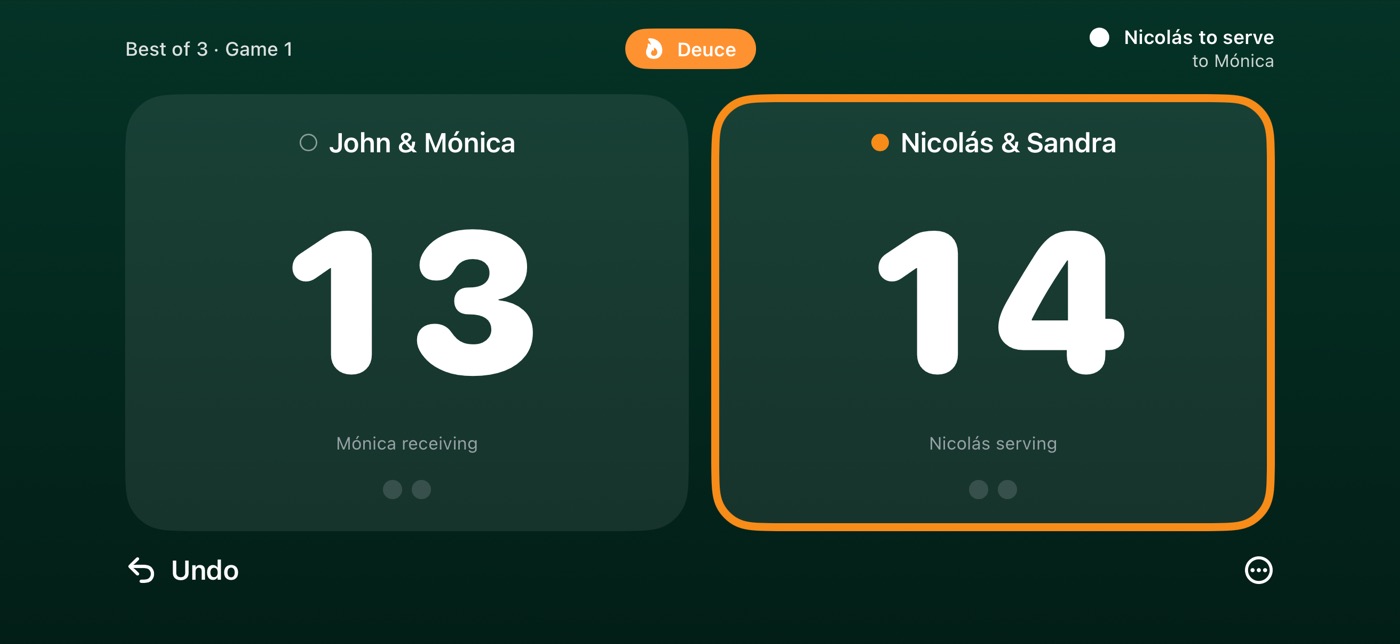
Where the serve goes
In doubles the ball must be served from the right half of the server's court into the right half of the receiver's court (diagonally). That is why the receiver is always one specific player: the one standing in the diagonal box.
Who starts the first game
The pair that has the right to serve first decides which of them serves, and the other pair decides which of them receives first. After that, the rotation above takes over.
How the order carries into the next game
The pair that served first in a game receives first in the next one. The pair now serving first picks which of them serves, and the first receiver is the player who served to that server in the previous game. In practice: the circle stays the same, it just starts one step later, and the pairs trade the opening serve every game.
What happens at deuce
At 10–10 the serve changes after every single point, but the same circle is used: the next server is still the player who was just receiving. Nothing resets, it simply goes around faster until one side leads by two.
The final-game rule
In the last possible game of a doubles match (the decider), the receiving pair swaps their receiving order when the first pair reaches 5 points, and the players also change ends. This keeps the players from being always on the same side of the table. Umpires apply it at official matches; in a casual game agree on it beforehand.
Serving out of turn
If someone serves or receives out of turn, stop play as soon as you notice, go back to the score where the mistake started and fix the order. Points already played in the wrong order stand only in a friendly game where both pairs agree.
Let the scoreboard remember
The circle is simple but it is easy to lose track in a long rally, especially at deuce when the server changes every point. PingPal shows who serves and who receives on the scoreboard in singles and doubles, applies the two-points-then-switch rule and the deuce rule automatically, and swaps sides at the right moments. Mis-tapped a point? Undo rewinds the score and the server together. Note that PingPal follows the standard rotation; for the final-game receiving change at 5 points, follow your umpire.
FAQ
How many points does each player serve in doubles?
Two in a row, until 10–10. From deuce on, the serve changes after every point.
Who serves first in the next game of a doubles match?
The pair that received first in the previous game serves first, and they choose which of them serves. The first receiver is the player who served to that server in the previous game.
Does the receiver change at deuce?
The receiver is always the partner of the previous server's opponent in the circle, so it changes together with the server. At deuce the circle just advances every point.
Can partners swap who serves in the middle of a game?
No. Once the first server and first receiver are set, the order is fixed for the whole game. Only the start of each new game allows a choice.